


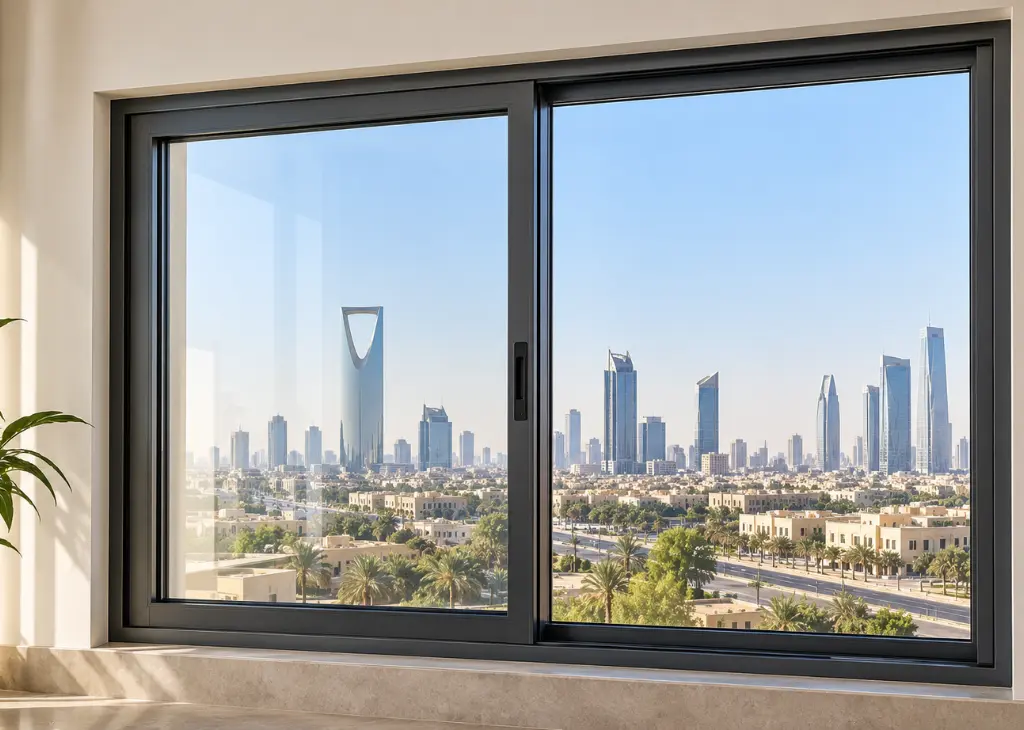
28 Sep Double Glazed Sliding Windows in Saudi: Design and Performance Guide
The selection of windows in Saudi Arabia has a considerable impact on home comforts and electricity bills. This article provides information on the principles of operation of double-glazed sliding windows in Saudi home buildings, influencing factors and practical recommendations for specification. It is based on aluminium profiles and custom glass options from Koemmerling Aluminium Systems.
Double-glazed sliding windows can reduce the thermal load. These sliding windows are convenient in terms of space (horizontal displacement), and increase ventilation, which is beneficial for the living room, kitchen and balconies. The sealed double-glazed unit keeps heat out.
Understanding the Structure of a Double-Glazed Window
A double-glazed window consists of two glass panes and a cavity with dry air or inert gas. The components of a double-glazed window include:
- Glass panes: different thicknesses and types affect the sound and thermal properties.
- Cavity: the size is usually 6-20 mm, and is best expressed in 12-16 mm with argon filling.
- Spacer bar: maintains the gap between panes, warm edge spacers reduce heat flow and prevent condensation on the inner surface.
- Desiccant: the special material in the spacer bar absorbs moisture to keep the cavity dry.
- Low-E coating: the coating reduces heat transfer, it is not included as an option, so it must be ordered.
Since stagnant air is a better insulator than glass, two panes with an intervening insulating space create almost twice the insulation. Argon and Low-E coating further improve the efficiency.
Sliding Window Designs for Different Spaces
Houses, villas and apartments typically require a large glazed opening that is tight when closed. Offices and shops have similar requirements, but with additional security. According to Koemmerling Aluminium, its systems use sliding profiles that remain consistent across large glazed openings to ensure smooth gliding and accurate alignment. The sliding system also includes high security, which may be a priority for offices or shops. The product range includes:
| Best suited to | Key benefit | Example system |
| Living rooms, kitchens, balconies | Horizontal movement, better ventilation, saves space | KS31.1 CL ES |
| Homes with wide openings | Stable profiles for large glazed areas, flexible design | KS31.2 CL ES |
Glass, Aluminium Profiles and Finishing Options
Aluminium is convenient for sliding windows, the material allows large areas of glass to be incorporated into the design. It is also recyclable, but the choice of profiles affects the thermal insulation. This can be achieved using thermal break technologies.
Glass choices to consider:
• Clear float glass: The simplest and most common option for double glazed windows
• Soft-coated Low-E glass: Designed for maximum insulation
• Air fill or gas fill: air-filled windows are lower in cost, and provide good insulation and noise reduction.
• Matched or asymmetric: Combination of panes for optimised acoustic performance.
At Koemmerling Aluminium, our solutions offer flexibility in shape, colour and function. This matters in Saudi Arabia, where a window has to suit the facade as well as handle the sun.
Thermal and Acoustic Performance Across Saudi Conditions
Windows are tested under particularly demanding conditions in Saudi Arabia, where temperatures often exceed 50°C in the summer, and where air conditioning is responsible for over 60 percent of residential electricity consumption.
The following elements contribute to thermal performance:
- Low-E coating: Minimises the amount of solar heat transmitted through the glass.
- Sealed gap: Two panes of glass with a layer of air in between provide twice the insulation value of a single pane.
- Thermal break: Minimises the flow of heat through the aluminium frame. The Koemmerling Aluminium has a range of sliding systems that uses a thermally broken design to minimise the heat.
Acoustic performance
Acoustic performance is determined by a combination of factors, including the number and thickness of panes, the type of glass and coating, the quality of the seal and the gas fill.
Argon-filled units have been proven to achieve approximately twice the noise reduction of air-filled units over a similar frequency range, and for homes situated close to sources of noise, asymmetrically glazed units can offer additional benefits. A high-quality seal and the use of a precisely mated sash prevent heat and sound loss through air gaps at the frame.
Selecting the Right Double-Glazed Sliding Window System
Some specific recommendations can be given for selecting double-glazed sliding windows:
- Determine the type of opening: large verandas require larger oversized systems, which may not be available for standard openings.
- Thermal properties: If the villa or house is located in a noisy area, it is worth finding out the options for the combination of panes.
- Finish: Colours, hardware and insect screens should be agreed before production.
- Choose an experienced installer. Even a well-specified unit performs poorly in a badly fitted frame.
Double-glazed sliding windows in Saudi perform best when the structure, glass, frame and installation are chosen together.
FAQs
For the vast majority of residential buildings, this is a cost-effective measure, since the expenditure on air conditioning dominates the electricity bill. The combined use of double glazed windows with wall insulation and shading structures gives the most positive results.
Double-glazed sliding windows require almost no care. Koemmerling Aluminium says that its aluminium systems are distinguished by resistance to environmental effects and do not require regular maintenance. A visual inspection of the condition of the unit is recommended.
Yes, double-glazing can improve thermal insulation and reduce unwanted heat transfer, which can help lower cooling costs.