


16 Sep Louver System Supplier: Types, Designs, and Applications
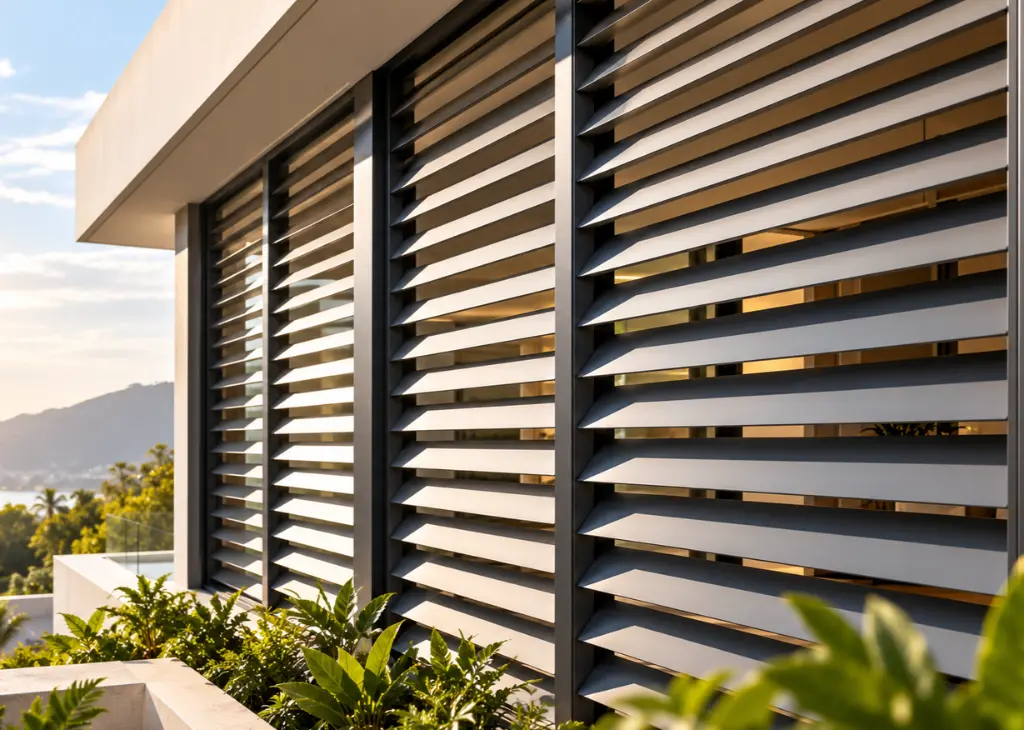
You’ve seen it before, even without knowing its name. Those angled aluminium blades on office facades, parking structures, stairwell and service areas; designed to permit airflow, reduce glare, keep out rain and add depth to a building’s exterior.
As India’s modern architecture leans toward glass-and-aluminium constructions, louver systems have an increasingly important role to play in balancing ventilation, sunlight and the visual appeal of residential, commercial and institutional projects.
In this guide, we’ll look at what a louver system is, the different types that exist, their common applications, why aluminium is the preferred material, factors to consider when choosing the right solution for your project, and how Koemmerling Aluminium can help in best possible way.
What Is a Louver System?
A louver system is a series of angled slats or blades installed across openings in walls, windows, roofs or the facade to let in natural ventilation while reducing the entry of rain, direct sunlight and airborne debris.
While louvers are commonly found to tackle HVAC and exhaust ventilation, their application in modern architecture stretches well beyond that; they can cover entire building facades, screen parking structures, create sunshades for glazing and improve the visual character of commercial and residential buildings. Depending on the design, the blades may be arranged horizontally or vertically and integrated into masonry, concrete or curtain wall systems.
Aluminium has become the preferred material for most louver applications due to its lightweight, corrosion resistance and design versatility that it brings to facade, ventilation and shading systems across a range of building types. Koemmerling Aluminium provides architectural louver solutions that can be integrated with modern building facades to support ventilation, clean exterior appearance, etc. Its aluminium systems offer flexibility for different architectural and project requirements.
Types of Louver Systems
Not every louver is designed for the same purpose. The blade profile determines how the system handles airflow, rain protection, etc.
| Louver Type | Purpose | Common Application |
| Fixed Louver | Continuous ventilation with no moving parts | Utility rooms, plant areas, parking structures |
| Adjustable Louver | Controls airflow manually or automatically | Commercial and industrial ventilation |
| Sand-Trap Louvers | Designed to reduce the entry of sand and larger dust particles | Useful in sandy and dusty environments |
| Sunshade Louver | Limits solar glare and enhances the facade | Offices, hotels, and glazed elevations |
Modern architectural projects are beginning to use sunshade louvers as both a functional and visual component. Their streamlined blade profiles allow for the control of direct sunlight, while also adding depth and rhythm to contemporary building facades, making it an integral part of climate responsive design rather than just a ventilation accessory.
Ventilation Louvers Design for Modern Buildings
A high-performance louver system has a few key factors which guide its design and application: blade angle, spacing, airflow and rain protection. Essentially, it’s about allowing for enough ventilation while preventing excessive water, dust and glare entering, thus finding the right balance between performance and protection.
In contemporary architecture, louvers are no longer treated as a standalone accessory but are planned as part of the facade from the beginning, with blade profiles aligned to the curtain wall grid for a cleaner and more integrated appearance.
Another trend that is seeing a rise is motorised louver systems. By utilising sensors and automating blade movement to help control sunlight and airflow throughout the day, commercial buildings can achieve improved comfort and support energy efficient building design.
Benefits of Aluminium Louver Systems
Aluminium has become the preferred material for modern louver systems due to its perfect blend of strength, durability and architectural versatility. Being lightweight, it allows for large facade installations without compromising performance.
Key features
- Lightweight & durable: Strong profiles allow for easy installation while maintaining long term stability.
- Corrosion resistant: Perform exceptionally well in coastal and high humidity climates.
- Solar shading: Louvers help to reduce direct sunlight before reaching the glazing, thus improving indoor comfort.
- Architectural flexibility: Range of powder-coated and anodised finishes with a variety of blade profiles.
- Low maintenance: Can withstand harsh weather with minimal upkeep.
- Recyclable: Sustainable material which can utilise existing properties when being reprocessed.
Rather than excelling in one particular aspect, aluminium delivers reliable performance across residential, commercial and institutional projects, making it a solid choice for contemporary facade design. Koemmerling Aluminium designs architectural aluminium products that combine high-end performance, functionality and contemporary architecture. The company’s louver systems are able to provide the flexibility to create a variety of design options for different needs, helping architects achieve practical and aesthetic building exteriors.
Applications of Louver Systems in Different Buildings
Louver systems are designed uniquely to cater to the specific needs of different building types, as every project has different ventilation and shading requirements.
- Commercial buildings: For facade shading, HVAC intake and exhaust and screening rooftop equipment.
- Residential homes: Useful for balcony screens, utility areas, stairwells and window sunshades.
- Industrial facilities: Helps manage airflow around machinery while protecting against dust and rain.
- Parking structures: Provides natural ventilation for vehicle exhaust.
- Hospitals & educational buildings: Facilitate continuous airflow and daylighting for improved indoor comfort.
A well-designed louver system often goes unnoticed and that’s exactly its purpose; it silently improves on ventilation, sunlight and protects the building without drawing much attention.
How to Select the Right louver System Supplier
There are a few factors which distinguish a good louver system supplier from a poor one.
- Material and finish quality: Ask what aluminium grade and finish they utilise. Powder coating, anodising and PVDF all age differently.
- Curtain wall compatibility: If the louver requires to sit inside a facade system, inquire that the supplier actually builds for that integration rather than providing bolt on solutions.
- Design and blade range: The supplier with more range of blade size and shape provides more flexibility around the shading performance a project requires.
- Track record and documentation: Ask for project references, test certificates. Established suppliers provide this over without much back and forth.
- After-sales support: Installation assistance and warranty conditions are more important to most people than they realize once the project is actually in progress.
One example of what such a supplier profile looks like on paper is Koemmerling Aluminium, a brand under the Profine Group that has more than 125 years of experience in the building materials space. A manufacturer with a proven track record, documented product portfolio and realised projects in the facade space.
The truth is very simple. A louver system is only as good as the supplier and so do your due diligence before you sign off a facade package not afterwards. It’s a small step but it saves a world of pain later.
FAQs
Fixed louvers have blades fixed at one angle and never move. This makes them cheaper and easier to maintain. Adjustable louvers allow for manual or motorisation of the blade angle providing greater control of airflow and light as the day progresses.
Yes. Sunshades and architectural louver systems are often designed to sit inside stick or unitised curtain wall frames as part of the same facade module, rather than being mounted afterwards as a separate fixture.
It depends largely on the finish. A typical powder-coated system typically lasts 20 to 25 years. A high-performance PVDF coating can extend this up to 30 years even in coastal or industrial conditions.